The Essential Guide to Keeping Warm Safely with a Hot Water Bottle

Popular sections:
How does a hot water bottle work?|How much money can you save?|How to choose the right hot water bottle?|How to check your hot water bottle is safe?|How long does a hot water bottle last?|How to fill a hot water bottle?|Filling a hot water bottle safely video|Using a hot water bottle to stay warm|Using a hot water bottle to ease aches and pains|Using a hot water bottle to improve sleep and reduce stress|Hot water bottles for kids|Storing a hot water bottle|Frequently asked questions
Purpose of Guide
Hot water bottles can be great for keeping you warm, whether it’s by warming up your bed in the winter, keeping you snug on the sofa while binge-watching a series or on a camping holiday in the summer.
In addition to keeping you warm, hot water bottles can save you money. They are also great for overall well-being, simultaneously helping you relax, relieve stress and menstrual pains, ease muscle tension, aches and pains, and get a good night’s sleep. All of these can be great for your short and long-term health.
That said, many people do not know how to get the most out of their hot water bottles safely and effectively. In this guide, we shall walk you through everything you need to know about what you can use a hot water bottle for, and how to get the most out of yours, safely.

Quick answer
- Water: let boiled water cool first and never use boiling water. Use water no hotter than 60°C, and cooler water for children.
- Filling: no more than two-thirds full. Rigid eco bottles are filled until the water is about 4 cm below the opening.
- Skin and bed: always use a cover or a towel, never sit or lie on the bottle, and take it out of the bed before you get in.
- Replacing it: follow the replacement period in the instructions supplied with your bottle, counted from first use. For most of our bottles this is around 2-5 years. Replace it sooner if it is damaged.
- Babies: do not use a hot water bottle for a baby under 12 months.
How Does a Hot Water Bottle Work?
A hot water bottle is a rubber or thermoplastic bottle with a hollow inner void into which hot water can be poured and stored. A screw cap lid or stopper is used to completely seal off the water from the surrounding air.
The rubber or thermoplastic bottle has insulating properties which prevent all the heat from the hot water from escaping right away. Instead, the heat is only able to escape gradually through the bottle and passes into whatever it touches, such as your body or bedding, and into the surrounding air, enabling the user to benefit from a sustained release of heat over a long period.
Over time the hot water in the bottle cools down as more heat energy is released and dissipated until eventually it reaches the same temperature as the surrounding room. At this point, there is no longer a difference in temperature driving the heat from inside the bottle to the outside environment and it is time to refill your hot water bottle - if you haven’t already done so.

Saving Money and Energy with a Hot Water Bottle
Hot water bottles aren’t just about warmth and comfort - they’re a brilliant way to save on energy bills while also reducing your environmental footprint. In the face of rising heating costs, a hot water bottle offers a cost-effective solution to staying warm without relying solely on central heating.
How Much Can You Save?
We conducted a study to understand how much you could save by reducing your thermostat and using a hot water bottle.
The numbers speak for themselves.
Over a year, we estimate the cost of heating water for your hot water bottle is as little as £7.20. At the same time, a hot water bottle typically costs around £20-30 and can last several years.
Compare this with the savings from turning down your thermostat by just 1°C, which the Energy Saving Trust estimates could save a typical UK household around £80 a year.
"Heating the Human, Not the Home"
Using a hot water bottle allows you to comfortably lower your thermostat without compromising warmth. Whether you’re working from home, unwinding on the sofa, or prepping for bed, a hot water bottle delivers direct and efficient heat.
Eco-Friendly Benefits
Lower energy consumption means fewer CO2 emissions.
By integrating hot water bottles into your daily routine, you not only cut costs but also play a part in a more sustainable future. It’s a win for your wallet, your comfort, and the environment.
What to Look for When Buying a Hot Water Bottle
Hot water bottles are sold in most supermarkets and pharmacies, although the range on offer is often small. Before you decide where to buy hot water bottles, check two things on the bottle itself. The first is the safety standard marking, such as BS 1970:2012, which is usually embossed near the neck. The second is the daisy wheel, which shows when the bottle was made.
A cover is also worth having. It protects your skin from direct heat and keeps the bottle warm for longer. Our hot water bottles meet relevant safety standards such as BS 1970:2012 or equivalent European safety standards, and our range includes knitted, faux fur and cushion covers.
How to Choose the Right Hot Water Bottle?
These days hot water bottles come in all shapes and sizes and are made using a variety of materials. Therefore, it’s important to understand the pros and cons of each option and choose the right hot water bottle for your specific needs.
The main aspects to consider are size, material, shape and presence of an outer cover.

Size
A large hot water bottle, (which we define to be at least 1.5 litres in size) will be able to store more hot water than a smaller one and hence more heat energy. Due to the ratio between its surface area and water capacity, all other things equal, it can be expected to release heat over a longer period. This would result in you keeping warmer for longer.
Larger hot water bottles are effective when trying to apply heat to or soothe a region of your body such as your lower back as they can target a wider area at the same time. This said, once filled they can weigh roughly twice as much as a small hot water bottle so people who are not as strong such as the elderly need to take extra care. A full 2 litre hot water bottle with a cover will typically weigh between 2 to 3kg.
Smaller bottles are lighter, easier to fill and easier to carry which means they are more effective at providing heat to a specific and localised area of your body especially when you need to lift and support it (e.g. if you are suffering from a stiff neck). Due to these properties, they are also preferred for keeping children warm.
Small hot water bottles or mini hot water bottles are also easier to look after and store. There is less risk of the hot water bottle becoming damaged as there is less material and less risk of burns and scalds. This is in part because they are lighter and fill time is shorter.
Material
Hot water bottles are usually made from rubber, but some are made from thermoplastics. Thermoplastic bottles are often more expensive, and some are recyclable. Our eco hot water bottles are made from over 90% renewable raw materials, tested to ASTM D6866, and contain no PVC or phthalates. Rubberless hot water bottles, including thermoplastic products, also avoid the odour that some rubber bottles give off.
Shape
Although most hot water bottles take on the familiar classic shape of a rectangular base with a neck at the top of one of its narrower sides leading to the cap, there are some more innovative designs which have been introduced in recent years. These modern hot water bottles have been either modified to improve their usability in certain scenarios or make them more visually appealing.
A notable example of a hot water bottle with an innovative shape is the heart shaped hot water bottle. Another is the long hot water bottle. They work just like typical hot water bottles but are a lot longer and narrower – taking the shape and appearance more of a long tube. This gives the long hot water bottle a lot more versatility and the ability to warm and soothe several parts of your body simultaneously, lie along a sofa, rest around your neck and soothe hard to reach areas such as your back. Although standard hot water bottles can be used for just about anything, extra long hot water bottles give you that extra versatility.
Outer cover
The cover, or lack of, is another important consideration. Nowadays there is an eclectic choice of covers to suit everyone's personal style including knitted covers, animal inspired hot water bottle covers and soft faux fur covers. Arguably the most exciting covers and a recent hot water bottle innovation are cushion covers for hot water bottles which are specially designed to store a hot water bottle inside. But don't worry you can still use a hot water bottle without a cover, however we still recommend wrapping it in a towel to prevent injuries.
How to Check Your Hot Water Bottle is Safe?
Before Purchase and First Use
When purchasing a hot water bottle or using it for the first time, make sure it meets a recognised safety standard. In the UK this is BS 1970:2012, which replaced BS 1970:2006. Bottles made elsewhere in Europe may be tested to an equivalent national or European standard, so check the product page or the instructions supplied with the bottle.
Where a bottle carries BS 1970:2012, it is usually embossed near the neck or beside the instructions.
You may also see a Kitemark on bottles made by a British manufacturer. Other countries use different marks. German bottles, for example, may carry a TÜV symbol or a tick in a square box.
Before Every Use
You must inspect your hot water bottle, including the stopper, every time before you use it.
Like any material, your hot water bottle is subject to wear and tear. Whenever you use a hot water bottle inspect the bottle and stopper for wear and damage including cracks, fading, or small holes.
How Long Does a Hot Water Bottle Last?
Replace a hot water bottle at the point stated in the manufacturer’s instructions, counted from the date you first use it. For most of our bottles this is around 2-5 years. If your bottle came without instructions, replace it about two years after you start using it. Make a note of the date you first use it.
Replace a bottle straight away, whatever its age, if you see cracks, thinning, stickiness, leaks around the stopper or a strong rubber smell.
Remember to always discard damaged or expired hot water bottles to avoid accidents. If you are uncertain it is always best to use a different hot water bottle.
Don't forget that how you use it matters. If a hot water bottle is properly used and cared for, it is more likely to reach its full recommended lifespan. But at the same time, negligent use like not emptying the water, heating it up in the microwave, or filling directly from a tap can speed up the hot water bottle decay.
How to Read the Daisy Wheel
Hot water bottles carry a small flower-shaped mark, called a daisy wheel, embossed on the neck or body. It shows when the bottle was made.
The number in the centre is the year of manufacture. For example, 25 means 2025. The 12 petals around it are the months, starting with January. The dots in a petal show the week of that month. Three dots in the fifth petal, for example, mean the third week of May.
Manufacturers use the daisy wheel to trace batches, and replacement is counted from the date you first use the bottle.
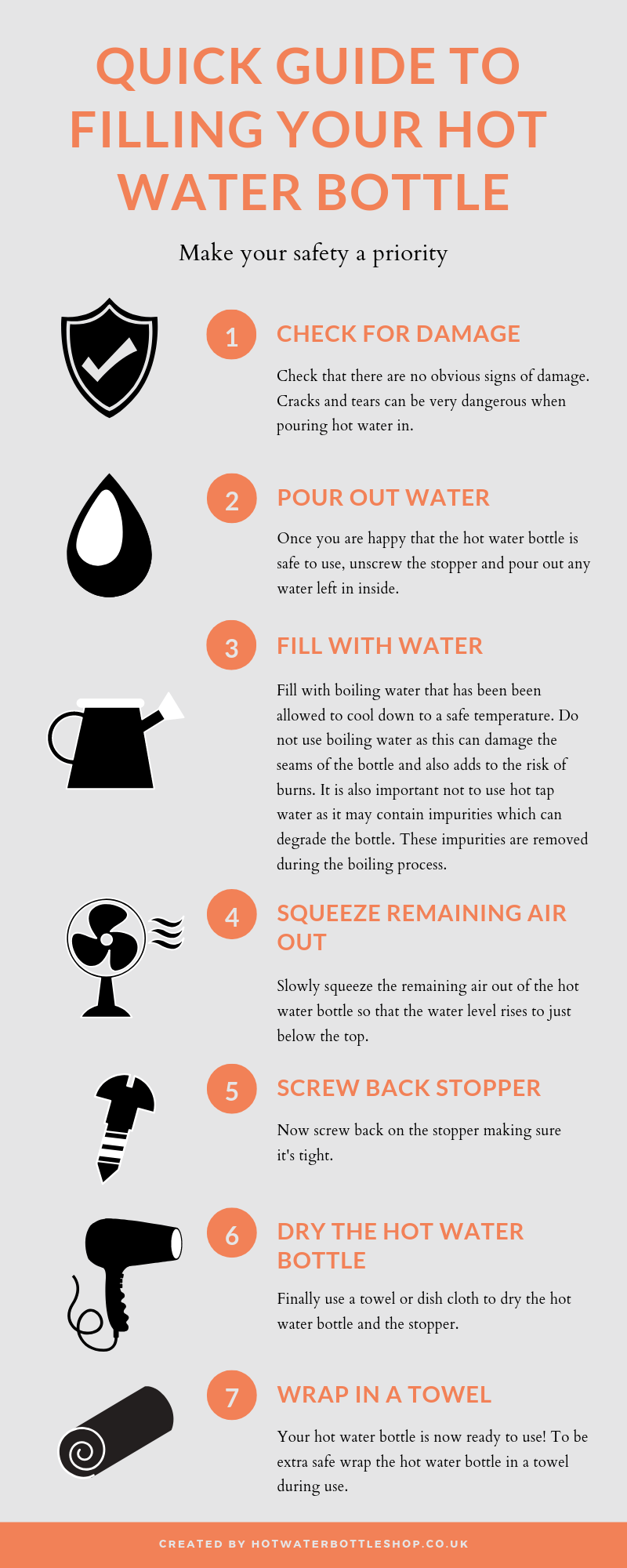
How to Fill a Hot Water Bottle?
The steps below are typical for filling a hot water bottle safely. They can differ from one bottle to another, so read the instructions supplied with yours carefully.
- Check the bottle and stopper for cracks, thin patches or other damage. Do not use the bottle if you find any.
- Empty it. Unscrew the stopper and pour out any water left from last time. A bottle should be stored empty, so there should not be any.
- Boil the kettle, then let the water cool. Use water no hotter than 60°C. Never use boiling water.
- Hold the bottle upright by the neck and pour slowly to avoid splashes.
- Do not fill it more than two-thirds full, or as your instructions state. Overfilling can cause the bottle to burst. Rigid eco bottles are filled until the water is about 4 cm below the opening.
- Remove the air. Squeeze a flexible bottle gently until water reaches the neck. Rigid eco bottles should not be squeezed, folded or bent, so skip this step for them.
- Screw the stopper on by hand until the bottle is sealed. Hand-tight is enough, so do not use tools.
- Dry the outside of the bottle if necessary, then put the cover on.
Boiling water and hot water straight from the hot tap can both shorten the life of a bottle, and boiling water adds to the risk of burns. Do not use a hot water bottle for a baby under 12 months. For older children, use cooler water than you would for yourself. See Hot Water Bottles for Kids. Never heat a hot water bottle in a microwave, oven or under a grill.
Avoid prolonged direct contact between your skin and the bottle, because of the risk of scalds and burns. If your bottle has no cover, wrap it in a towel.
Filling a Hot Water Bottle Safely Video
What Are Hot Water Bottles Used for?
Traditionally the main use of hot water bottles has been for overall well-being including keeping warm, improving relaxation, relieving stress, easing pains and aches, as well as improving sleep. Although this is still largely the case, there are some other surprising benefits. It's also becoming increasingly popular to use your hot water bottle during meditation.

Using a Hot Water Bottle to Keep Warm and Relaxed
There are two main ways to keep you warm with a hot water bottle. The first is by resting it on or close to your body and the second is to use it to heat up the inside of your bed or sleeping bag before entering.
You can rest the hot water bottle close to or on you when in and around the house – for instance, when sitting down on the sofa. You can also carry it with you on a leisurely walk during the winter months, or when you walk to work on a chilly day. Make sure the stopper is tight, and never lean on, press against, sit on or add any excessive pressure to a hot water bottle, including with your feet.
Hot water bottles are also great for keeping your bed warm when you are about to go to sleep. Simply leave the hot water bottle under your blanket for 5-10 minutes before you intend to enter. Don’t forget to remove the hot water bottle before you enter as there is a risk of injury or bursting once you enter (and fall asleep). Never use a hot water bottle in a bed fitted with an electric blanket.
The same method works in a sleeping bag when camping: warm the bag for a few minutes, then take the bottle out before you get in. Let boiled water cool first, as you would at home.
During cold weather, in addition to using a hot water bottle, it's important to also take necessary steps to keep warm as well as eat well.
Using a Hot Water Bottle to Ease Aches and Pains
Many aches and pains including neck aches and muscle aches are common from time to time and, although a nuisance, are often nothing to be overly worried about. If problems persist or you are unsure, you should seek medical advice.
If you are suffering from an uncomplicated form of pain or ache then heat and cold products may be effective forms of treatment and relief. Some hot water bottles can also be used for cold therapy. Check your bottle's instructions before using it this way.
Dr. Brian King from UCL says that, “Heat deactivates the pain at a molecular level in much the same way as pharmaceutical painkillers work." His research showed that when heat of over 40°C was applied to the skin it switched on heat receptors at the site of the pain. These temporarily blocked chemical messengers that caused pain to be recognised by the brain.
On the contrary, cold numbs the injury by narrowing blood vessels and slowing down blood flow. This in turn, reduces the build-up of fluid in the affected area. Cold is also believed to help with inflammation and swelling. It relieves pain but does not necessarily treat the underlying cause.
Heat therapy is frequently used during rehabilitation, or when a person is suffering from deep tissue injuries, back, neck or muscle pain, joint stiffness, headaches or migraines. Heat has relaxing properties, helping to relax stiff and sore muscles and joints. Heat not only relaxes but also stimulates blood flow and improves circulation, thereby increasing your range of motion and reducing soreness and stiffness.
Heat therapy is not advisable for treatment of acute injuries or pain, as well as for inflammation, bruises and swelling. For these problems, it is advisable to use a cold treatment such as an ice pack or frozen wheat bag. Cold treatment is best for reducing post-exercise inflammation or pain. This is why you often see athletes having an ice bath following a game. Cold treatment is also effective when the injury is recent, red, inflamed or sensitive.
If your bottle can be used for cold therapy, apply it to the affected area for up to 15 minutes. Keep a cover or towel between the bottle and your skin to prevent injury from prolonged exposure.
Here is a summary of which form of treatment may be most effective for your problems:

Using a Hot Water Bottle to Improve Sleep and Reduce Stress
Our modern way of life has led to higher levels of stress, anxiety and sleeping difficulties. It is a well-known fact that long-term stress and sleeping difficulties can have adverse consequences on an individual’s health. Although heat products such as hot water bottles cannot target the root causes of the stress and sleeping difficulties, they can be very effective as forms of relieving some of the symptoms. If problems persist for a significant period, then you would be best advised to seek medical advice.
The impact of stress and anxieties along with difficulties in sleeping can be reduced by using heat products such as a hot water bottle. The science behind this is quite simple: heat helps you to relax. It does this by stimulating blood flow and improving circulation around your body. Furthermore, heat also has the effect of making you more comfortable in your surroundings. Have you ever tried to fall asleep in a cold room? Hot water bottles can also be used to warm up your bed before you get in.
Generally, a single hot water bottle is sufficient for general blood stimulation around your body. It is important to remember that you should not forget to target the less obvious parts of your body such as your feet. A 1999 study published in Nature found that warm feet are linked to falling asleep faster.
For assistance getting to sleep, place a hot water bottle under your blanket at least 5 to 10 minutes before you intend to enter. Once you are ready to enter, you must remove the hot water bottle as there is a risk of bursting or scalding.
If you can’t sleep because it is too hot, check your bottle's instructions before using it to cool the bed. Once you are ready to sleep, you must again remove the product first.
Hot Water Bottles for Kids
Hot water bottles can keep children cosy in cold weather, but children burn more easily than adults, so extra care is needed. Do not use a hot water bottle for a baby under 12 months. Some health bodies, including the Children's Burns Trust, advise families to avoid hot water bottles for children altogether. If you do use one, follow the rules below.
- An adult should always fill the bottle. Children must never fill one, and should never squeeze one.
- Always use a cover, and keep the bottle away from bare skin.
- Children should not sit on the bottle, press it with their feet or take it into bed. Warm the bed, then remove the bottle before the child gets in.
- Supervise children, and never leave a child alone with a hot water bottle.
- Use cooler water than you would for yourself. Hugo Frosch, for example, advises no hotter than 40°C for children under 3, which is much lower than the 60°C it gives for adults.
- Check the minimum recommended age if one is given, and read the instructions supplied with the bottle.
Store hot water bottles out of reach of children. Young children can damage them without realising.
Other Vulnerable People and Hot Water Bottles
People who cannot feel heat properly, such as some people with diabetes, and people who are ill, frail or unable to move a bottle away from their body should never be left alone with a hot water bottle. If in doubt, ask a doctor before use.
Storing a Hot Water Bottle
Remember it’s the little things you do every time you use your hot water bottle that will help it last longer.
After each use, empty the hot water bottle completely and, if possible, hang it upside down to dry. Only once the inside is completely dry should you take it down and store it in a cool, dry and dark place with the stopper removed. Sunlight can cause the material to oxidise, and storing a wet bottle can cause mould to grow inside. Keep the bottle away from hot surfaces, household chemicals, oil and grease, and do not put anything on top of it while it is stored.
Once a hot water bottle shows signs of wear or damage, discard it right away so that nobody else uses it. For optimal safety, replace a bottle at the point stated in the manufacturer’s instructions, counted from first use, even if it shows no signs of wear. See How Long Does a Hot Water Bottle Last?
Cleaning a Hot Water Bottle
Cleaning instructions vary from bottle to bottle, so read the instructions for yours before you clean it. Unless they say otherwise, rinse the bottle with clean water. Check the sewn-in care label or equivalent for instructions on how to clean your cover.
Disposing of Your Old Hot Water Bottle
Follow the manufacturer’s disposal advice. If your bottle is marked as recyclable, recycle it where facilities allow. Otherwise, dispose of it with normal household waste. If you are struggling to throw your favourite hot water bottle away, you can reuse it as something else, such as a tablet cover or a knee cushion. A retired bottle should only be reused this way and should never be filled with hot water again.
Frequently Asked Questions
How hot should the water be in a hot water bottle?
Use water no hotter than 60°C, which is the maximum manufacturers such as Hugo Frosch recommend. Never use boiling water. Let freshly boiled water cool for a few minutes first. Use cooler water for children, as described in Hot Water Bottles for Kids.
Can you put boiling water in a hot water bottle?
No. Boiling water can damage the material, shorten the life of the bottle and increase the risk of burns if it splits. Let boiled water cool first.
How often should you replace a hot water bottle?
Follow the replacement period in the instructions supplied with your bottle, counted from first use. For most of our bottles this is around 2-5 years. If your bottle came without instructions, replace it about two years after you start using it, or sooner if it shows any sign of wear or damage.
What does the flower on a hot water bottle mean?
It is the daisy wheel, a date mark that shows when the bottle was made and that manufacturers use to trace batches. The number in the centre is the year, the 12 petals are the months and the dots in a petal show the week. See How to Read the Daisy Wheel.
How long does a hot water bottle stay warm?
It depends on the size of the bottle, the cover and the temperature of the room. A larger bottle holds more water, and so more heat, and a thick cover slows the loss of heat.
Can you sleep with a hot water bottle?
Use it to warm the bed, then take it out before you get in. A bottle left in the bed can be pressed on during sleep, which increases the risk of bursting and burns. Never use a hot water bottle in a bed fitted with an electric blanket.
Can you use a hot water bottle for a baby?
No. Do not use a hot water bottle for a baby under 12 months. For older children, see Hot Water Bottles for Kids.
Can you microwave a hot water bottle?
No. A standard hot water bottle should only be filled with water. If you want a product you can heat in the microwave, see our microwave wheat bags, which are designed for it.
That's All For Now...
Hot water bottles are great and effective ways of keeping you warm, reducing stress, easing aches, alleviating pains, and helping you sleep. This guide has covered how to get the best use out of yours safely and even how you can recycle them when you have stopped using them.


